
RASTROS
100 cases.
One path.
Someone left a trail.
You can reconstruct it.
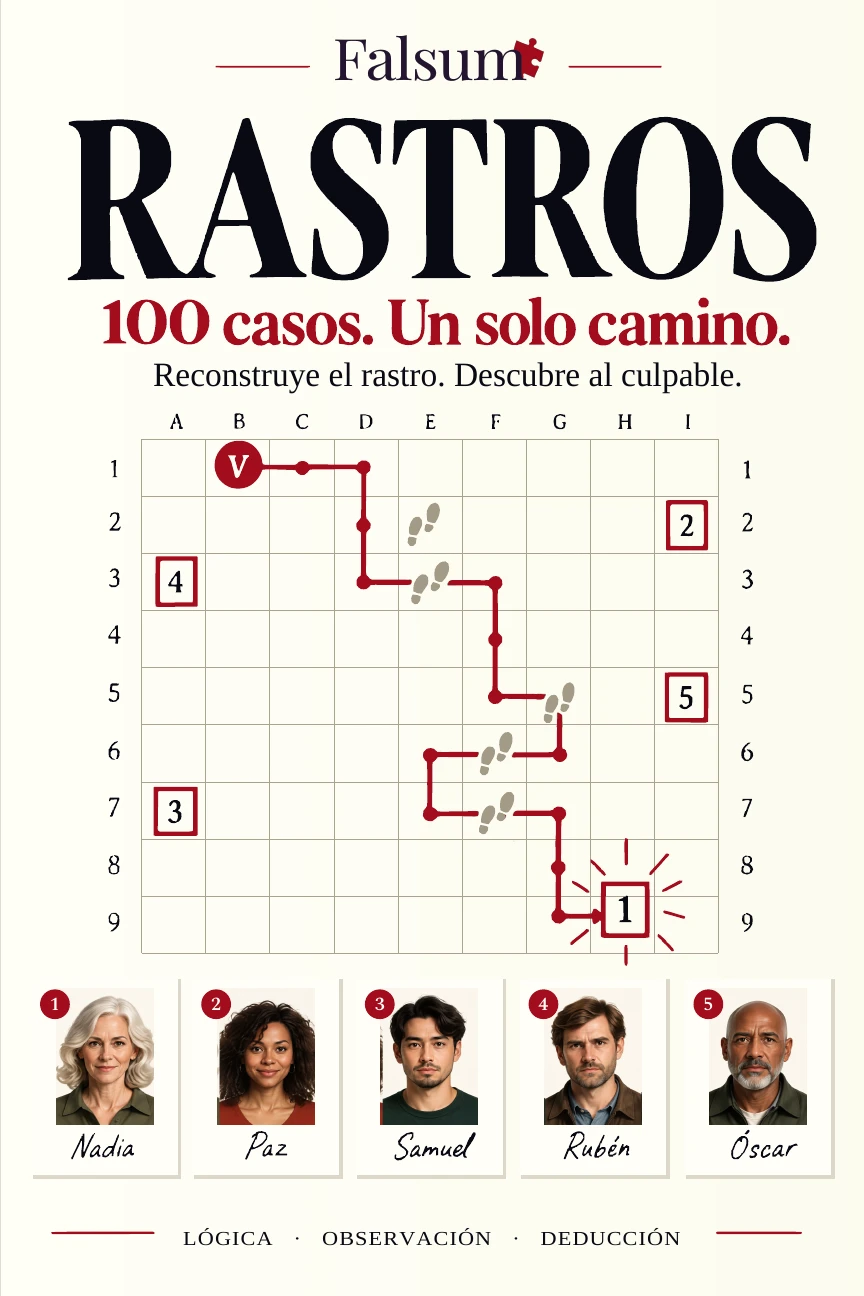
One victim. Several doors. A single path leads to the culprit. The evidence is on the board: read the numbers, connect the footprints and rule out what does not fit.
Complete solutions
Field guide · Game rules
How to play,
step by step.
With a pencil and eraser, reconstruct one continuous path from V, the victim, to one numbered door, passing through every confirmed footprint. Each door belongs to a suspect: the final door identifies the culprit.
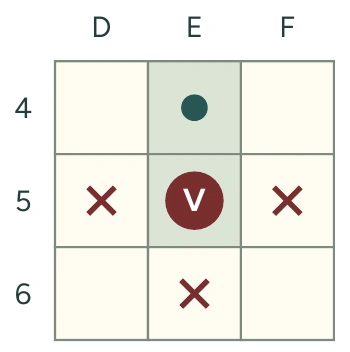
Only one way out of V
The footprint above already connects to V. Cross out left, right and below: the victim can have only one trail neighbour.
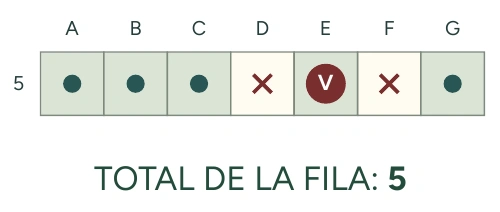
V counts too
This row needs five cells. V counts as one; with D and F ruled out, A, B, C and G must be dots. That completes the total.
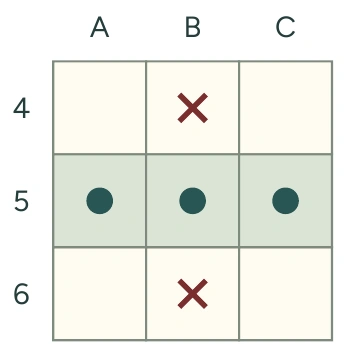
Two neighbours, no more
The central dot already has a neighbour on each side. Cross out above and below to avoid a branch.
- V
- Victim: the start of the path.
- ●
- Footprint or confirmed cell: the path goes through here.
- ×
- Excluded cell: the path does not go through here.
- Empty cell
- You do not yet know whether it belongs to the path.
- Numbered square
- A suspect's door: only one is the end.
- Dash in a total
- The total is hidden and must be deduced. It does not mean zero.
Mark dots and crosses
Use a dot to confirm a cell and a cross to rule it out. Printed footprints are already required dots. Keep uncertain marks separate until you can justify them.
Move along the sides
The path moves up, down, left or right. Sharing a corner does not connect two cells: there are no diagonal moves.
All trail cells that share a side are connected. You cannot ignore that contact even if you do not draw a line between them.
Count the neighbours
V and the final door must have exactly one trail neighbour. Every intermediate cell must have exactly two. If an intermediate dot already touches two, cross out its other sides: a third would make a branch.
Respect the totals
The number for each row or column shows how many path cells it contains. V, the footprints and the final door also count. When you reach a total, cross out the remaining cells. If every available cell is needed to reach the total, mark them.
Keep one open chain
The finished path can have no branches, loops or isolated sections. You may discover separate sections as you play, but they must all join eventually. Four dots in a 2 × 2 block make a loop: if three are already there, rule out the fourth.
Find the door and check
The path ends at exactly one door. The other doors are ruled out and cannot be crossed. Before making your accusation, check every visible total, every footprint and every cell connection. The number on the final door identifies the culprit.
What if I get stuck?
Count the rows and columns again, check the neighbours and look for footprints that would become isolated. You can test a hypothesis: if marking a cell breaks a total or makes a connection impossible, rule it out. If crossing it out leads to a contradiction, mark it.
Keep only deductions you can prove. The book has gradual hints and solutions: use the hints one at a time, because each assumes you have made progress. If you check the solution, return to the board and try to justify every step.
At your own pace
One pencil.
One clue.
One more case.
One hundred independent cases let you return to the board whenever you like. Start with the easier ones and work towards expert level. If you get stuck, gradual hints help you keep investigating.
More mysteries to discover.
RASTROS · First steps
Ten cases to get started.
Download the two free RASTROS booklets, with colour puzzles, hints and solutions. The PDFs are in Spanish; the cases are also available in English on this site.
Downloadable puzzles and solutions →Sample 01 · ten cases to get started · Sample 02 · ten new cases